Connecting the Mind maps
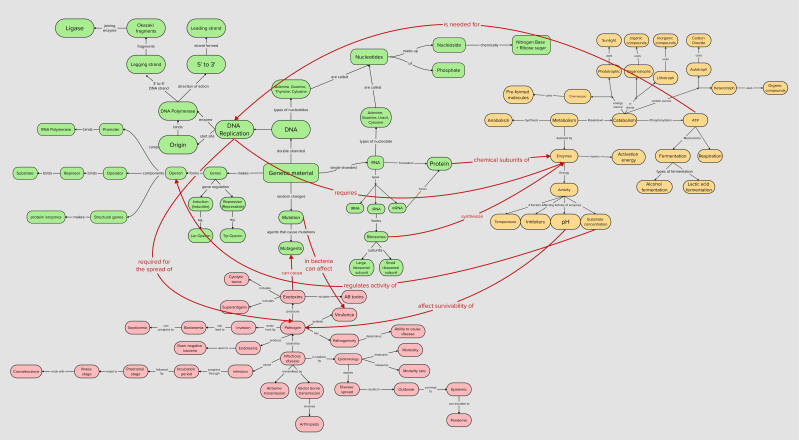

Mind Map Connections
1) ATP → DNA Replication (ATP required for DNA Replication)
2) Protein → Enzymes (Enzymes are composed of protein)
3) DNA Replication → Enzymes (DNA Replication requires enzymes)
4) Substrate concentration → Operon (Operon activation depends on substrate concentration)
5) Pathogen → pH (Pathogen survivability depends on pH of external environment)
6) DNA Replication → Pathogen (Pathogen require DNA replication for spreading)
7) Ribosomes → Enzymes (Ribosomes synthesize enzymes as they are protein)
8) Exotoxins → Mutations (Exotoxins can induce DNA mutation in host)
9) Mutation → Virulence (Mutation in bacteria can affect their virulence)
Description Regarding the New Connections
The connections I created between my mind maps show how most of these cellular processes are interconnected in microorganisms and how they depend on each other to function properly. For instance, ATP is connected to DNA replication because it provides the energy required for replication to occur, which is essential for cell growth and reproduction. DNA replication is also closely linked to enzymes, since enzymes such as DNA polymerase are needed to build new DNA strands accurately and efficiently. On top of this, proteins are directly connected to enzymes because enzymes are specialized proteins that catalyze biochemical reactions in the cell. Ribosomes also play a key role in this process, as they are responsible for synthesizing these enzymes, again since they are protein and ribosome is responsible for translation of mRNA. Altogether, these connections highlight how energy, structure, and function are all tightly linked within the cell.
Another set of connections focuses on how environmental and regulatory factors influence microbial activity and survival. Substrate concentration is linked to operon function because operons are activated or repressed depending on the availability of specific molecules, allowing the cell to conserve energy and resources. Similarly, pathogens are connected to pH because their ability to survive and grow depends heavily on environmental conditions. If the pH is too extreme, it can disrupt enzyme activity and end up preventing the organism from functioning properly. These connections show that microorganisms are not only controlled by internal processes but are also constantly responding to changes in their environment in order to survive.
The final group of connections relates to infection and disease, showing how microorganisms can impact human health. Pathogens depend on DNA replication in order to multiply and spread within a host, which allows infections to progress which in turn, helps the microbe spread. Exotoxins produced by pathogens can damage host cells and may even lead to mutations in host DNA, making infections more severe. Mutations can also occur in the microbes that cause diseases, which can influence virulence, since genetic changes in microorganisms can increase or decrease their ability to cause disease. Overall, these connections demonstrate how molecular processes, environmental factors, and pathogenic mechanisms all work together to influence microbial behavior and disease outcomes in a real-world context.
xxxxxxxxxxxxxxxx